Profiles Fall 2025



Swipe For More >
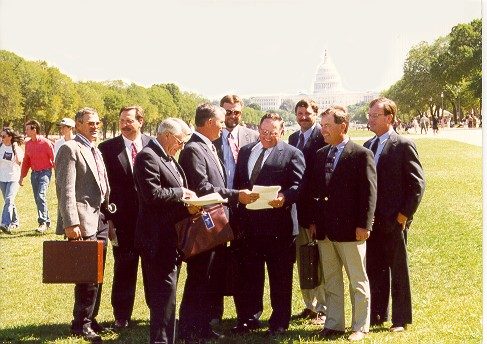
In 1955, five sorghum producers gathered around a table in Hereford, Texas, with a shared concern: sorghum had no seat at the table as federal farm programs were taking shape. Other commodities were represented. Sorghum was not.
That meeting, led by producers who understood the stakes, set in motion what would become the National Sorghum Producers. Their goal was straightforward but ambitious: organize, be heard, and ensure sorghum growers were not left behind.
Within a year, they succeeded. In 1956, sorghum was included in the Federal Farm Program for the first time. It was an early win, and it established a defining trait of the organization that still holds true seven decades later: progress comes from producer leadership and persistence.
NSP was built by growers who worked all day in the field, then drove miles to meet late into the night. They transitioned, often reluctantly but effectively, from producers to advocates. Their work was rooted in practicality, promoting the crop, improving demand, and influencing policy not for prestige, but for survival.
Over time, the challenges evolved. The mission did not.
As hybrid sorghum emerged in the late 1950s, yields surged and the crop’s potential expanded. What had once averaged fewer than 20 bushels per acre doubled in just a few years. Production increased, acres expanded, and sorghum’s role in U.S. agriculture grew rapidly.
That growth demanded markets—and NSP helped build them.
Working alongside other feed grain organizations, early leaders helped establish what would become the U.S. Grains & BioProducts Council, laying the groundwork for international market development. Export education, feeding trials, and relationship-building overseas began decades before most growers ever saw the results.
By the 1960s and 1970s, sorghum was no longer just a regional crop. It was becoming a global one.
But progress was never linear.
As demand grew, producers recognized the need to reinvest directly in their crop. State checkoffs began emerging, starting in Texas, allowing growers to fund research and market development. This producer-led investment model spread gradually across the Sorghum Belt, reinforcing collaboration between state organizations and the national association.
At the same time, agronomic challenges demanded attention. Greenbug pressure threatened yields across the Plains, prompting NSP to work closely with public researchers and private industry to accelerate the development of resistant hybrids. The result was not just improved varieties, but a model for cooperation that remains central to sorghum research today.
The 1985 Farm Bill brought major change to U.S. agriculture, including the creation of the Conservation Reserve Program. While CRP provided environmental and economic benefits, it also removed millions of sorghum acres from production in a short period of time.
The impact was stark—and instructive.
For sorghum growers, it underscored a reality NSP continues to emphasize: policy decisions, even well-intended ones, can have bad consequences on our industry if we are not fully represented.
In the years that followed, NSP expanded its advocacy footprint. The organization became increasingly active on regulatory issues, pesticide access, and trade negotiations. Dedicated representation in Washington strengthened NSP’s ability to respond quickly and effectively as policy debates intensified.
Leadership development also became a priority. Producers were not just funding the organization, they were stepping forward to testify, negotiate, and speak for their crop at the highest levels.
That emphasis on leadership would prove critical in the years ahead.
By the late 1990s, farm policy again came into sharp focus. Financial pressures mounted, and growers made clear what mattered most: fairness.
In the 2002 Farm Bill, NSP secured one of its most consequential policy victories with the equalization of the sorghum loan rate to corn. This change helped producers weather the very low prices in 2004 and 2005 — resulting in over $231 million of increased price support in those two years.
It was a reminder that sustained advocacy delivers measurable results.
Recognizing that traditional trade association models were not sufficient for a smaller commodity, NSP’s board made a pivotal decision: diversify funding and modernize organizational structure.
For-profit subsidiaries were approved as an alternative revenue stream, followed soon after by the establishment of the National Sorghum Checkoff. Driven by growers in a grassroots movement, the checkoff created a national framework for investment in research, promotion and market development.
The checkoff did more than fund projects. It allowed sorghum to compete for matching dollars, leverage partnerships, and stretch producer investments further than ever before.
As NSP entered its seventh decade, genetics emerged as a defining priority. Advances in genome sequencing opened doors for accelerated improvement, while collaboration across public and private sectors positioned sorghum to compete in a rapidly evolving landscape.
At the same time, domestic demand expanded. Sorghum’s recognition as an advanced biofuel strengthened its role in renewable energy. Ethanol plants across the Sorghum Belt increasingly utilized the crop, reinforcing demand closer to home.
Food, feed, and fuel—once separate conversations—began to converge.
Trade remains a cornerstone of the sorghum economy. While markets have shifted over time, NSP’s approach has remained consistent: diversify, build relationships, and stay engaged.
From long-standing export channels to emerging markets in Southeast Asia and beyond, the organization continues working to expand access and reduce risk. Trade wins are rarely immediate, but decades of effort have shown that persistence pays off.
As NSP CEO Tim Lust often notes, many of today’s successes are the result of work done 10 or 20 years earlier—quiet, deliberate groundwork that only becomes visible later.
Perhaps the most encouraging development is the next generation of producers stepping into leadership roles. While they may approach participation differently than previous generations, their engagement is focused, informed, and intentional.
Through leadership programs, advocacy training, and hands-on involvement, young growers are shaping the future of the organization and the industry it represents. Their ability to learn quickly, communicate effectively, and leverage technology is changing how sorghum’s story is told.
From five producers in Hereford to a national organization navigating global markets, complex policy, and evolving consumer demand, NSP’s history is defined by adaptation without losing purpose.
The issues will continue to change. Markets will rise and fall. Policy battles will be won, and revisited.
But the principle that launched the organization in 1955 remains intact: sorghum growers are strongest when they stand together.
As National Sorghum Producers marks its 70th anniversary, the focus is not on nostalgia. It is on momentum—built by generations of producers who understood that the future of their crop was worth fighting for.
The future is bright. And it was earned.